





As your partner in revenue growth, our main purpose is to help you maximize available resources. We help you to scale your business by generating new sales and/or obtaining needed funding.
Unfortunately, many business owners miss out on substantial amounts of money each year. This is due to unclaimed federal and state tax credits. By including tax incentive recovery into our range of services, these overlooked funds will contribute directly to your profits.
These credits don’t require repayment, offering a significant cash infusion without debt. Credits can be swiftly reinvested into marketing and innovation initiatives we’re developing together.
Consider this as an essential boost for your growth strategy; while our digital marketing efforts capture additional market share and funding solutions facilitate expansion, these recovered tax incentives provide capital you’ve already earned through hiring, innovation efforts, business assets, etc..
NūbizSoho.com has partnered with top industry specialists to deliver an effortless, compliant service. This partnership enables you to concentrate on your core operations while we uncover every dollar owed to you. Beyond tax season, this approach strategically enhances cash flow and eliminates resource waste, paving the way for greater profitability in your business endeavors.
COST SEGREGATION SERVICES
What is Cost Segregation?
Cost Segregation is a strategic tax savings tool that allows companies and individuals, who have constructed, purchased, expanded or remodeled any kind of real estate, to increase cash flow by accelerating depreciation deductions and deferring federal and state income taxes.
In general, it is easy to identify furniture, fixtures, and equipment (FF&E) that are depreciated over 5 or 7 years for tax purposes. However, a Cost Segregation Study goes far beyond that by dissecting construction costs that are usually depreciated over 27 ½ or 39 years.
The primary goal of a Cost Segregation Study is to identify all construction-related costs that can be depreciated over 5, 7 or 15 years. Reducing tax lives results in accelerated depreciation deductions, reduced tax liability, and increased cash flow.
Conducting a quality study involves review of cost details and blueprints, site inspection, photo documentation, cost estimation, and preparation of the report.
Benefits of Accelerated Depreciation
The depreciation of a property with a Cost Segregation Study allows for a significant increase in deductions within the first 5 years.
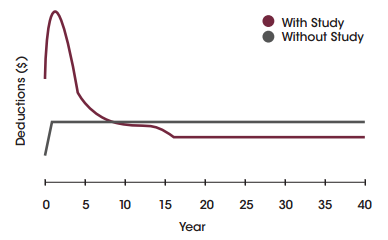
Assuming a combined tax rate of 41% and a return on investment factor of 8%, every $100,000 of costs shifted from 39-year property to 5-year property creates a present value tax benefit of approximately $22,000.
Every $100,000 of costs shifted from 39-year property to 15-year property creates a present value tax benefit of approximately $12,000.
< The graph illustrates how a building’s depreciation schedule would look with a study vs. without a study.
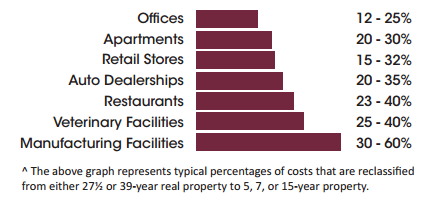
Property Type & Percentage Reallocated
Who Can Benefit?
Any structure used for business or as rental property is eligible for the benefits of Cost Segregation. Leasehold improvements or renovation costs may also qualify. These are just a few examples of the types of results from a study.
Please contact us for more information on your specific property type.
Timing is Everything
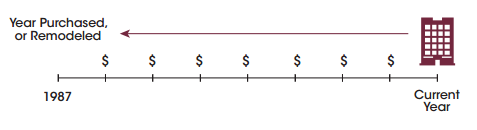
The ideal time for a Cost Segregation Study can vary depending on an owner’s tax situation.
Although the optimum time for a study is during the year a building is constructed, purchased, or remodeled, a study can be completed anytime afterward.
👉 In fact, current Internal Revenue Service procedures make it easy to go back, and claim missed depreciation on assets acquired as far back as 1987 without amending prior tax returns.
Our experts will help analyze your tax situation to identify the right timing for you.
RESEARCH & DEVELOPMENT TAX CREDIT
Thinking Beyond the TECH World
The term “Research & Development” often times provokes thoughts of lab coats and test tubes to taxpayers that are initially presented with the subject. However, for tax purposes, the definition of research & development is quite broad.
Companies engaged in the development, improvement or refinement of products, processes, formulas, and software should speak to an R&D tax credit expert for a review of their facts and circumstances.
What is the R&D TAX CREDIT?
The R&D Tax Credit is a federal tax incentive (also available in most states) designed to promote innovation in the United States. The credit is a dollar-for-dollar reduction in a taxpayer’s tax liability for a given year.
Primarily an activity-based incentive, qualifying expenditures can apply to a broad range of activities including, but not limited to:
- Developing or testing new products or materials
- Developing new or enhanced formulations
- Testing new concepts
- Improving existing products
- Trial and error experimentation
- Designing tools, jigs, molds and dies
- Design and analysis of prototypes or models
- Developing or improving production or manufacturing processes
- Developing, implementing or upgrading systems/software
- Paying outside consultants/contractors to perform any of these activities
QUALIFYING INDUSTRIES:
- Aerospace & Defense
- Automobile
- Architecture
- Chemical & Formula
- Engineering
- Food Science
- Manufacturing & Fabrication
- Foundries
- Life Sciences & Pharmaceutical
- Machining
- Software Development
- Tool & Die Casting
Why Now and Not Before?
Monetization has never been easier. Qualified small businesses may now apply for the R&D Tax Credit against Alternative Minimum Tax (“AMT”).
Additionally, qualified startup companies may elect to use up to $500,000 of R&D credits against their payroll taxes.
The R&D Tax Credit is an often overlooked and misunderstood tax benefit. Most tax preparers only associate R&D with technology, biotechnology, and pharmaceutical activities.
👉 Treasury regulations have substantially broadened the range of taxpayers eligible for the credit. As a result, more companies can take advantage of these benefits.